
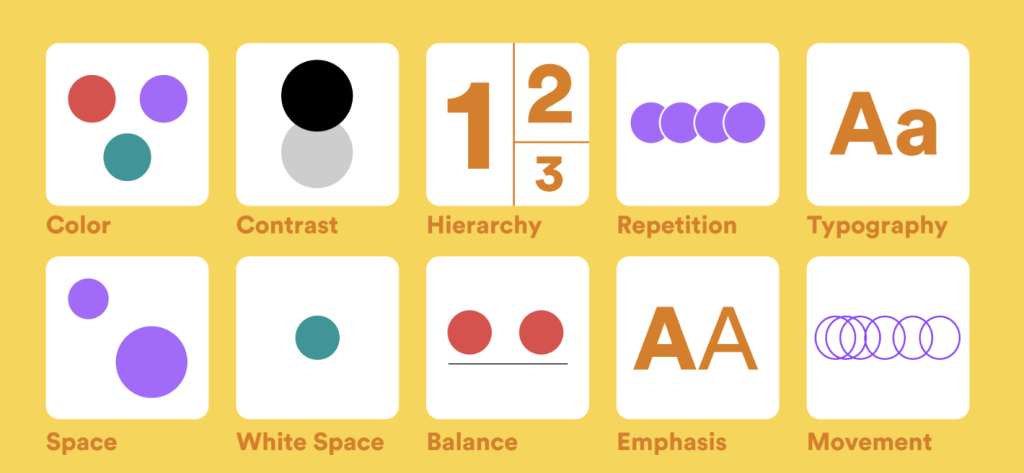
Understanding key design principles is crucial for creating effective and impactful visuals. Here are ten essential principles every graphic designer should know:
1. Balance
Achieving visual stability through symmetrical or asymmetrical distribution of elements.
2. Contrast
Using opposing elements like color and size to create interest and highlight important areas.
3. Alignment
Ensuring elements are visually connected and organized, providing structure and coherence.
4. Hierarchy
Arranging elements to show their order of importance, guiding viewers to key information first.
5. Repetition
Reinforcing consistency by using the same elements throughout the design, creating a unified look.
6. Proximity
Grouping related elements together to organize information and enhance readability.
7. Space
Using white space effectively to make designs look open, highlight key elements, and reduce clutter.
8. Color
Applying color theory to evoke emotions, create mood, and establish visual hierarchy.
9. Typography
Choosing and arranging text to enhance readability and convey the message’s tone and style.
10. Unity
Ensuring all elements work together cohesively, creating a harmonious and complete design.

Conclusion
Applying these principles can elevate your graphic design work, making it more engaging and visually appealing. Whether it’s a logo, website, or marketing material, these fundamentals are key to successful design.
Hi, this is a comment.
To get started with moderating, editing, and deleting comments, please visit the Comments screen in the dashboard.
Commenter avatars come from Gravatar.